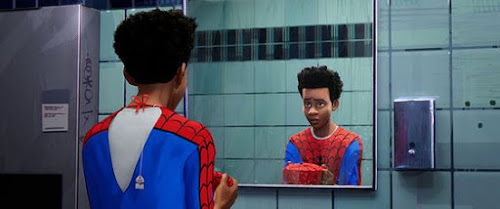
Tuesday, September 8, 2020

Film Review: Spiderman - Into the Spiderverse

           Rare but precious are the times when I sit down to enjoy a story and midway through realize it's a story I've been needing to hear. 

         My latest viewing of Spiderman - Into the Spiderverse would be one of those times.

         Those that know me probably know that I've been going through a lot of changes in my life lately -- learning how to get car insurance, moving into my own apartment, trying to deepen my Christian existence, etc. 

          Hot tip: No matter what anyone may have told you in the past, those things are pretty intimidating. And especially more so for someone like me, who's main talent is overthinking everything into existential crises. Every day questions pop into my head like:

          "What if I can't pay the rent?"

          "What if I lose my job?"

          "What if my interests and dreams are all meaningless?"

          "What if I let everyone -- including myself -- down?"

          So it was a startling but comforting realization when I was trying to explain the whole premise of Into the Spiderverse to a friend and it came down to: 'Miles Morales [the main character] is a young man who is trying to find where he wants to go in life, but is intimidated by the responsibilities and expectations placed upon him. And then he becomes the next Spiderman.'

          And if you know anything about Spiderman, you know that with great power comes great responsibility.

          But what happens if your powers just aren't enough?

(All copyrights belong to Sony, MARVEL, etc. I don't get any money from this.)

Overview: Getting into the Web-head's Head

        We've been through dozens of Spiderman renditions throughout the years, but for myself, I find that the ones that linger the longest are the ones that don't necessarily focus on the Spiderman, but on the humanity of being Spiderman.

         To really do this with style, the filmmakers made the decision to heighten Miles' problems by comparing him with several other male authority figures and a pair of kids who are much more successful than himself.

         First there's his dad, a straight-laced, successful police officer, who pushes Miles to test himself and become a better man. 

         Then there's his Uncle Aaron, the epitome of cool, who takes him out at night to express his artistic nature by spray-painting subway tunnels and gives him advice on how to impress the girls at his new school.

         After this, due to a super-villain's reality-shifting machine complication, we meet the rest of the spider-gang, and through this start looking at Miles' situation through the lenses of their masks, and we can see their problems -- For example, one Spiderman explores the idea of an adult who has failed and disappointed people, and now has no idea what to do anymore. Another Spiderman explores the concepts of grief and survivor's guilt, and whether or not it's better to get close to people when your life is so dangerous.

       Oh, yeah, this is a kids' movie.


(All copyrights belong to Sony and MARVEL, etc.)
(Do not try at home.)


       And then there's the villain.

      Normally I'd say that if a villain isn't connected with the hero in some way, they won't work out, but in this case the Kingpin is a very compelling antagonist, as he embodies everything that Miles is not. He's in control, he has a vision for the future, he's confident, he's powerful, and most of all, he isn't scared. He can do whatever he wants. But that doesn't always lead to fulfillment.


Fair Warnings

     For the most part, this is a rather family-friendly film. There's the standard amount of superhero punching, kicking, and animated violence. However, there are two scenes portraying car accidents, one scene of a character being shot (no blood is shown) and two characters are supposedly crushed to death (neither of which are shown on-screen, but we can sense the result.) There's also a sprinkling of profanity, though mostly from the Kingpin and his gang, so you could take that as a reflection of their immorality (like ye classic novels of old.)

      Also, more as a general health warning, there are several sequences which include rapid flashing lights and colors, so if you have epilepsy, use caution.

Conclusion

       The classic adage goes: "With great power comes great responsibility."

           But nobody ever really talks about the alternative, "With great potential comes great adversity."

           Growing up is rough. It seems like everyone else has it down while you're messing up at every turn. And sometimes you actually are. But you'll never know what you can do until you try. It's a leap of faith.

           Consider this movie a hug to all those going through change.


           Plus, y'know, it's got more Stan Lee Easter eggs than any other MARVEL movie AND has some pretty cool twist villains, so if that's not going to convince you to watch it, I don't know what else would...


Tuesday, June 30, 2020

We read ANOTHER Amish romance (Part 1)

     Question: 
             If we were so disappointed in the last Beverly Lewis Amish romance we read, why are we reading another?

      Answer: 
               1. We're looking to see if the last one was just a fluke -- the obligatory bad stretch for authors -- or if there are consistent patterns in her writing. 
               2. It makes us so much more confident in our own writing.

      And no, Seasons of Grace was not a fluke. In fact, it was fairly good compared to this.

The Parting

    Nellie-mae Fisher is a young Amish woman in the 1960s. Her younger sister drowned earlier that year and the entire family is badly shaken because of it. But Nellie's grief competes for the spotlight with Caleb Yoder and his "admiring gaze". 
     However, Caleb -- a 'free-thinking' young man -- must make sure that Fisher family has no dark secrets in their past to appease his father before his attraction to Nellie becomes too serious.
     Meanwhile, in the midst of grief, Nellie's father, Reuben, discovers the truth of salvation and begins to question the traditions of their community.

The Characters 

     Oh, where to begin...

     There are honestly enough terrible characters to be their own blog post...

     We are introduced to Nellie-mae through a first-person prologue which begins with her asserting that her baking is far better than her mother's in every way. 

      That's basically all you need to know to about her personality.

      This attitude continues throughout the book, with Nellie condemning her sisters for being gossips, envious, weak-willed, and stout while she is clearly too good to fall prey to such vices. She's the perfect Amish woman -- hardworking and traditional, no matter how much she may pine for forbidden guitars to be brought to the youth gatherings.
      Also, every bit of her pettiness and self-centeredness is obviously fine because the other characters deserve it. Her older sister often leaves her waiting, so why not take the long route for an errand specifically to make said sister late for work?
      At least her characterization is consistent, as horrible as it may be.

      Caleb is a manipulative creep with the backbone of a pool noodle. Moving on.

      Nellie's elder sisters, Rhoda and Nan, are portrayed as jerks because they don't spend time with Nellie -- though, considering her personality, who could blame them?
      However, this is not to say they are without flaws. 
      Nan is snide and likes to spread discord among the family.
      Rhoda, well.... Rhoda's personality really gets fleshed out in the second book. Let's say that in this book, her terrible, shameful personality flaws are 'works for Englishers' and 'fat'. (Excuse me a moment as I go on a tangent about this. Considering the setting of this story, I can understand how working for 'Englishers' would be seen as not-so-great, but the way her physicality is addressed is just plain cruel. Don't get me wrong, obesity is very unhealthy, but it seems to be the style of these books that anyone not distinctly slender or lean is immediately 'plump', or 'ample', or "like a pumpkin about to roll off." Yeah. Obviously that will have no impact on young women of stocky build who read this. None at all.)

      I would talk about Suzy (the younger sister who drowned) but her character is only fully appreciable with the plot-twist development that happens near the end. 

     Nellie's older brother, Ephram, is an ice-blooded scum king. He and Nan are almost completely alike, except for the added bonus that he doesn't refer to his wife by name (using instead 'her', 'she', or 'woman') and oversees all her visits to make sure the conversation stays within his parameters of 'suitable for well-behaved Amish women.'

     Nellie's mother, Betsy, is exceedingly codependent on her children and has a rather creepy fascination with her granddaughter who resembles Suzy.

     Nellie's dad, Reuben, is unquestionably the best person in the entire family. His care for his family goes beyond just the physical needs, and he eagerly seeks to understand the Scriptures as well as he can and deepen his relationship with God (much to the disbelief and fury of their local bishop.)

     And then we have the subplot of Rosanna.

     Rosanna is Nellie-mae's dear friend (tells you a lot about her already.) She and her husband have not been able to have any children of their own, and this in turn has made her very discouraged. Now, I would sympathize with her except for what happens next. Her cousin Kate comes to her and cheerfully tells her that she's going to give her her next baby (with the context that she and her husband rarely agree about anything, but he readily agreed to this.)

(Property of Nickelodeon, not used for profit.)


   Then throughout the book Kate starts wavering about her promise, and Rosanna complains that it's so inconvenient and wonders what's wrong with her. Obviously she's never been a mother before, since she doesn't grasp the basic concept that a mother might maybe be emotionally attached to her children.
   Though Kate's caveat that they might keep the baby "if it's a boy" doesn't make me that sympathetic towards her either.

Alternative Title: The Worst Community on Earth

    I really hope that Amish society has changed since the 1960s.
    Problem is, researching it is nearly impossible. 
    I need to see if my local library's open yet...

    So in my review of 'Seasons of Grace' I mentioned that the community presented was rather cultish. Well, this community - of Honeybrook, Pennsylvania - makes it look like Sesame Street nextdoor to Panem.

    Honeybrook boasts a variety of attractions, including (but not limited to)

         - Churches where the sermons are only preached in High German, which nobody but the elders understand, so you've just got to listen close and you'll miraculously begin to understand what the words mean.
         - Be advised, you are only allowed to read Scriptures sanctioned by the local bishop, and we openly discourage meeting together to study and discuss the Scriptures independently, as such would be rebellion against our ministers, who are "divinely ordained" by drawing lots.
         - Social activities like laughing about animals literally being worked to death.
         - Courting traditions, which involve the young woman sneaking out of her house without telling anyone where she's going, who she'll be with, or how long she'll be gone, to go and wait for her beau out in the woods - ALONE. AT NIGHT. Once he arrives, they'll drive all over the county together, and maybe (if they're the more risque type) go find a covered bridge to do some necking in (Beverly's words, not mine.)
         - Embraced sexism! "God made boys to be tough and hardworking, and girls -- well, they were supposed to be soft and sweet and mighty submissive." (We would also hope that if any first-time mothers visit, their firstborn is a boy, because that's how it always ought to be.)

         Yup.


    Summary

    You know those nightmares where something horrible is happening and you know it's a dream, but when you wake up you're hit with the realization that it could be real?
    This book is like one of those.

    I could go into a whole tangent about how dangerous the romanticization of the Amish lifestyle is in general, but this... this would require deep study just to know how far that tangent would have to go. Maybe some other time.

    Due to overlapping circumstances, our reading schedule is sort of on hold right now, but our church library should be opening (hopefully) by mid-July, so we'll see what happens then.

    I hope a meteor strikes the town and only Reuben escapes. 
    That'd be so nice.

Monday, June 22, 2020

Movie Review: Tron Legacy

     Okay, to be upfront: I don't typically like reboots/remakes. Most of the time they're worse than the original, and are only useful as paperweights or cash-grabs (Disney's 2019 Aladdin is an exception, but I'll talk about that later.) 
     But I was willing to give Tron Legacy a try. The first one was pretty okay, maybe a 7/10 for me, so how much worse could the sequel be?

    Well... it's complicated.

Overview

     27 years after the events of the first film, Kevin Flynn has disappeared. Nobody knows why he would or why he could, especially not his son, Sam. 
    Then one day Sam finds out a message was sent from his dad's office in the abandoned arcade. He goes down there to see what he can find and is accidentally teleported onto the Grid. But this virtual world is very different from the paradise his father told him about in bedtime stories. The users are hated -- as they are said to enslave programs -- and a program by the name of Clu has risen up to be the overlord of a 'perfected' society. But Clu doesn't know where Kevin Flynn is either. So he's very happy when Sam is conscripted into the arena games. What better bait could he have asked for?

Story and Characters

    From the premise, I was a bit more invested in this film than the original (I'm sorry, Original fans, forgive me.)
    Part of the reason is probably because I really like stories with a lot of family dynamics and emotional growth, but the other part is basically because the protagonist's goal was a lot more consistent and impacted nearly every decision he made. 
    To be blunt, in the original film Flynn's goal developed from 'Prove I made the program,' to 'Survive the game,' which ended with him just getting the proof he wanted in the end. Sam's goal always stays fairly within the ballpark of 'Get dad back,' even as he's trying to survive, because what's the point of going back to the normal world if he can't have his father with him?
    However, his character arc seems a bit stilted in the end, as the ultimate decision of change isn't made by him, but forced upon him.
    I really appreciated the fact that his reactions to being transported to the Grid are incredibly realistic, though. Great job on that, director/screenwriter/actor team!

   Kevin Flynn's arc is a bit more satisfying, in that he goes from a self-preserving 'what happens will happen, just stay zen' mindset to actively pursuing goals for the sake of his son.

   Clu was a much more entertaining villain, as he has all of K. Flynn's traits, skewed by his ideals of perfection and mathematical calculation. But because of this, he comes off more as Kevin's villain, not Sam's, which makes their conflict really impersonal. For an example, when they find out Clu's reprogramming programs into mindless soldiers, Kevin is sorrowful, guilt-ridden, and horrified, while Sam's reaction is more along the lines of an American patriot.
   At least Clue does fight Sam, though.

  Also more connected with Clu and his crusade of perfectionism is the rebel program, Quorra, who has been living with K. Flynn as his apprentice ever since he disappeared. As far as obligatory strong female characters go, she actually wasn't that bad, because:

            A. She had a unique personality
            B. She had dreams and goals of her own
            C. When she caused a problem which risked all of their lives, she apologized for it

   (Man, that bar is so low...)
   
   However, above all this, I've got to say that the direction choices and editing stunted a lot of character appreciation for me, for instance:
   "Why is Sam just crouching on the floor for 15 seconds during this fight scene, watching programs get shredded apart? Oh, yeah, so we could have Quorra do that sick jump over him. I see."

Plot

   Genuinely not bad. Sam's an incredibly impulsive and emotion-driven character, so his decisions keep the plot moving at a steady pace, and the worldbuilding of the new Grid gives a lot of nice challenges.

The Fatal Flaw

   Generally I'd say this is a good example of the importance of music to a film. I understand that one of the main attractions of this film is that the soundtrack was composed by Daft Punk (who makes a cameo in the film) and it's fairly good, but it's overall tone is disconnected from everything on screen, floating above the film so it makes scenes that should be emotionally gripping fall flat. If your protagonist is screaming in fury/terror but the music sounds like something from a techno spa, it's not going to work.

   Also this film was smothered in the latter acts by a ton of Buddhist philosophy which was really distracting from what should have been the primary theme of a father and son trying to reconnect after years of separation and estrangement, rather than, 'Be zen, answers will fall into your lap -- Oh wait, you mean I've actually got to make decisions that require self-sacrifice and further abandoning my son? Uh, it's fine. He'll get over it. Because he'll learn to be indiff- I mean, zen.'

Summary

   I had high hopes for this movie. Then the second and third acts came along and slapped those hopes in the face. The visuals were nice, but no amount of computer graphics in the world can cover up a forced and bad moral theme.  
   Probably a film I'd watch again only to spark deep philosophical discussions with friends.
   5/10.


Monday, June 8, 2020

Movie Review: Tron

    You know what the biggest problem with legendary old movies is? 
     You really have no way of knowing what they're like until you watch them. 
     Because they're so popular, no one bothers to review them anymore, and most of them came out before 1984, so the only real ratings at the time were G and R (which wasn't really accurate until much, much later, which is why us kids got the VERY suggestive bar song in The Great Mouse Detective, but couldn't watch The Ghost and The Darkness, which is debatably less violent than Lord of the Rings.)

     But now I've gotten myself a subscription to a streaming service and guess what I found!!!

(Alternative title: Epileptic Triggers 101)


      Due to pop-culture and the sequel, you're probably familiar with the premise: A man gets transported into a computer, and there are epic Frisbee fights. 

      Sorry to bust the bubble, but only the first part of that really applies to this film. 

The Story & Plot

     Before we begin, a clarification:
     Story is the why characters do things, such as Frodo wanting to protect the Shire and the friends he loves.
     Plot is how characters do things.
     This movie is an example of all plot, minimal story.

     Early on, Flynn says he has to hack into Encom to prove that he created a game his boss is now taking the credit for, but nothing in the rest of the film reflects this moral conflict, except for the concept of the Master Control Program absorbing other programs to make itself bigger.
     Being pulled into the game, Flynn's focus abruptly changes to breaking the MCP so he can escape.

     Admittedly, I wasn't too invested in the tension because SPOILERS >> I knew a bunch of the characters make it to the sequel<< SPOILERS but also because the characters themselves didn't seem that invested in them either. Maybe it was just a thing of the era. 'When all seems hopeless, might as well go to your doom quietly, unless you're the main character!'


The Characters

   The characters are all pretty simplistic, but not horribly so. Despite what I said about the lack of tension in the previous category, the actors themselves are very good and have just the right amount of earnestness in their portrayals, neither being cardboard or melodramatic.

    Sark, though.

    Sark is the primary villain, tasked by the MCP to kill Flynn in the games. Sark boasts to the MCP that he's grown tired of fighting accounting programs and the like, but is too afraid to take on a user. So we end up with a villain whose specific task is to kill Flynn, but he and Flynn NEVER have a direct confrontation (except for when he's boasting about capturing Flynn, then saunters off.) 


The World

     The most popular view of Tron was about how it utilized computer-animation to portray the computer world, and, predictably, it's a bit underwhelming to us now, but I can see how shocking it would be to audiences back then.

      As for worldbuilding, I think I'd be able to appreciate it more if I was a programmer, because then I'd understand how the different programs function better. 

    I did like the detail that programs take on the appearance of their makers, and regard their makers as somewhat divine, because that makes sense, given the situation. However, if the filmmakers were trying to draw some real-world parallels with this, then it gets hairy later on when one of the programs asks Flynn if they [the users] have a plan, and Flynn says that there is no plan. 

Negative Details

   One scene.
   Flynn's ex-co-workers come to visit him and he makes several comments that imply that the female co-worker has had sex with him and that she is now having sex with the male co-worker (or at least is living with him,) and that he himself is willing to do it again. 
   That's it.

   I'm honestly surprised it's only that much!

Conclusion

   All in all, I'd say a pretty okay movie. Not very engaging, but alright. Probably a good sick-day movie.

   I'm hoping the sequel is better.

Tuesday, May 19, 2020

The World is Watching - How Should Christians Respond to Covid-19?

      I didn't want to write a post about Covid-19, but here we are, the times have brought us here.

      Unless you've been seclusion for the past six months, or are just stepping into the era of life when we're all more aware and concerned about the news around us, I don't need to give much backstory on the issue.

     Covid-19 is here, that's that.

      BUT that's not all that. Half of a pandemic is the pandemic itself, the other half is how we humans respond to it. And frankly, the majority response from the Christian field has been a bit disquieting.

      For credentials, I've seen everything in social media posts from likening the government's response to Orwel's 1984 society to posts about the recklessness of reopening everything immediately. Also I listen to the World And Everything In It morning podcast (not a sponsor, I just think it's cool.) I assume those on social media also are listening to the news, so this is not to discredit them, this is just to say that I am also paying attention to the situation, and this is my take.

      Disclaimer: THIS IS NOT A POLITICAL POST. 

      This is just me looking at the Bible, looking at the pandemic, and offering a theory about how we could properly respond.


     Part One: What is the Government's Order?

     So what actually is the government telling us to do?

     Well, in North Carolina, these things happened:

      - An order that no more than 10 people could gather in a home at a time
      - The playgrounds and schools were closed
      - Most big-name stores were closed
      - Restaurants only provide drive-through or delivery services
      - Bars were shut down
      - Grocery stores had varied responses (Whole Foods is a very different place from Lowes Foods at the moment.)
      - We were generally advised to stay 6 feet apart (however, this was not strictly enforced in parks)
      - Churches were shut down, but are slowly opening up again (yes, it took a federal judge to get us that part, but judges are part of government too.)

      Other states, from my understanding, are under very similar restrictions, but the rate of easing them is varied (my greatest sympathies to those in New York.)

      But are these orders unconstitutional?
      I looked into the bill of rights just now and the only amendment that seems to relate to these circumstances is the first.

     "Congress shall make no law respecting an establishment of religion or prohibiting the free exercise thereof, or abridging the freedom of speech or of the press, or the right of the people peaceably to assemble and to petition the government for a redress of grievances."
                                                                                                                   - Bill of Rights, 1791

     As with most everything, let's look at the context.

     "Congress shall make no law respecting an establishment of religion or prohibiting the free exercise thereof..."

     'Establishment' is primarily used today as a synonym for 'place' or 'building'. However, in the historical context of the bill, 'establishment' refers to the creation of a state government. Remember, this was written shortly after the United States split from a country with a long and bloody history of monarchs establishing state religions and persecuting those who didn't agree with it.

     Furthermore, even though our churches were closed, they were not ordered to dissolve. We still have the right to meet through live streams, conference call technology, and with small groups or individual brothers and sisters in Christ.

    "... or abridging the freedom of speech or of the press..."

    Now, Facebook and other social media platforms have taken the liberty to delete posts from their users spreading news about Covid-19 that they deem false or misleading, which is highly suspicious, but Pinterest does the same thing if you request it, and there is no record of the government actually telling them to do that as of yet.

    "... or the right of the people peaceably to assemble and to petition the government for a redress of grievances."

 
  The Oxford comma is a wonderful thing, and can alter the meaning of a phrase so simply. However, as it isn't present here, my interpretation of the amendment is that the government cannot make a law preventing people from peaceably gathering to petition the government to pay for grievances that it (the government) has inflicted.

    But even if these orders are leaning on the rights, are they really telling us to do anything wrong?


   (My background did a weird thing after I pasted the following quote and I can't fix it, so... yeah.)

    Part Two: Rights vs Right


    One of the most disturbing things I've seen in response to our pandemic state is this quote from a Mr. Ted Nugent (who is evidently an American singer-songwriter) that was posted by a confessing Christian.

    Behold:

   “Why do I have to stay home just because 𝘆𝗼𝘂 are scared? How about 𝘆𝗼𝘂 stay home....𝘆𝗼𝘂 stay in 𝘆𝗼𝘂𝗿 house indefinitely, 𝘆𝗼𝘂 wear a mask, 𝘆𝗼𝘂 socially distance yourself from me, 𝘆𝗼𝘂 avoid restaurants, 𝘆𝗼𝘂 avoid baseball games, 𝘆𝗼𝘂 stay off the roads, 𝘆𝗼𝘂 avoid malls and beaches and parks, 𝘆𝗼𝘂 believe the made up death numbers, 𝘆𝗼𝘂 believe the media hype, 𝘆𝗼𝘂 get your toxic vaccine while avoiding vitamin C, sunshine and the things God gave us to actually heal, I'm done playing 𝘆𝗼𝘂𝗿 dumb game...I'm no longer staying in my house or catering to 𝘆𝗼𝘂 because 𝘆𝗼𝘂 are scared. I'm not wearing a mask and I'm not staying 6 feet away from you anymore because I'm not afraid of you. You are not my enemy and if I get sick, it's not because of 𝘆𝗼𝘂, it's because of me and my system..."


   .........

   .............
   *Deep breath *

   This is probably going to get me mugged outside a Texas Steakhouse, but I strongly disagree with this quote. Namely because while there's a lot of *yous* in it, the entire focus of it is *me*.


  'Why do I have to stay home just because you are scared? How about I tell you were to go, I get to go outside, I get to go to restaurants, I go to baseball games, I go to the mall and beaches and parks - by the way, you're an idiot - and I'm not going to do things because they make you feel better. I will invade your space because I'm not scared. I take responsibility if I get sick, but I don't care if I make you sick.'


  I find the masks very uncomfortable too. 

  I miss going to the movies.
  I miss having hugs.

  But I was thinking the other day, what does Scripture say about this?

    
   "And one of the scribes came up and heard them disputing with one another, and seeing that He answered them well, asked Him, "Which commandment is the most important of all?" Jesus answered, "The most important is, "Hear, O Israel: The Lord our God, the Lord is one. And you shall love the Lord your God will all your heart and with all your soul and with all your mind and with all your strength.' The second is this: 'You shall love your neighbor as yourself.' There is no other commandment greater than these.""
                                                                                                              - Matthew 12: 28-31

   Christianity should not be a *me* real estate. If anything, the greatest hurdle of Christianity is dying to oneself (this is not to say self-abuse is right, but that's another blog for another day.)


   I find the masks very uncomfortable, but perhaps its best to wear them around those who are the most likely to have bad reactions to the disease - and who knows who that is in the grocery store.

   I miss going to the movies, but understand that if we open the theaters back up again without any restraints, there would be sold out shows everywhere and those same people who are likely to have bad reactions - who are most definitely also if not MORE depressed in this time - aren't going to be able to enjoy themselves or feel safe.
   I miss having hugs, but I'm not going to demand them from people, regardless of how they feel.
   I can hardly wait until we can all meet up and have fun again, but until then, we've got to keep our heads.

   Complying with the government orders about Covid-19 shouldn't be a matter of fear among the Christian community, but it should be one of love.


   "Therefore I tell you, do not be anxious about your life, what you will eat or what you will drink, nor about your body, what you will put on. Is not life more than food, and the body more than clothing? Look at the birds of the air: they neither sow nor reap nor gather into barns, and yet your heavenly Father feeds them. Are you not of more value than they? And which of you by being anxious can add a single hour to his span of life? And why are you anxious about clothing? Consider the lilies of the field, how they grow: they neither toil nor spin, yet I tell you, even Solomon in all his glory was not arrayed like one of these."

                                                                                                                 - Matthew 6: 25-29

   A quick little fact: the hills of Israel and covered with rocks. It's hard to imagine so many rocks until you see pictures of it. And yet a few bright, beautiful flowers are able to grow in ground so harsh as that.

  This is exceptionally hard teaching to remember when you don't have a job, but there it is, in bright red ink.

   The world is watching, and what will they see?


Tuesday, May 12, 2020

Book Review: Sister of the Bride


     We've all been under a lot of stress lately, and we all need a break from the antagonism and the politics and the gloom - that and we haven't finished reading the next Beverly Lewis book we scrounged up. So, in the interim, I thought I'd review some books I actually enjoyed!

    Let's start off with Beverly Cleary's 'Sister of the Bride'.

    Honestly, I didn't even know this book existed until a couple weeks ago, which is odd, since Beverly Cleary was a big thing at the libraries of my youth.
    Boy, that makes me sound old...

    ANYWAY, 'Sister of the Bride' is the story of 16-year-old Barbara MacLane, her elder sister's wedding, and the lack of romance in her own life.
    Before you go running off, Cleary actually addresses the last subject very uniquely, in that this story isn't so much about romance, but rather growing up to be ready for romance -- a view seldom explored in today's stories.
   
     While there is a love triangle in play, the way it plays out is also interesting in that neither guy is wholly good or bad by the end. The one boy, Tootie (unfortunate, yes,) is attentive and compassionate, but struggles with self-esteem issues*. The other, Bill, takes Barbara for granted, but is sincere and goes above and beyond to apologize to her.

     (*Now, Tootie's self-esteem issues manifested themselves in a 'woe is me' attitude in the opening chapter, which manipulated Barbara into saying "I like you," which led to Tootie immediately asking her out to the movies, so at first I didn't like him, BUT can we collectively take a moment to thank Beverly Cleary for using this circumstance to show how uncomfortable a situation that is and the fact that just because you care about someone of the opposite gender doesn't mean you're in love with them AND that even if a person annoys you, you can still care about them (and vice versa.))

     The original publishing date was in 1963, so some aspects are very aged, but not so much as to be horribly distracting, and otherwise it's a nice example of what life was like back then.

     Overall, a simple, vivid book that once more showcases Cleary's gift of depicting growing up in the middle of chaos.

Saturday, April 25, 2020

On Heroines (the Writer's Dread Terror)

    So I've been trying to write a novel for a while, but right now it's a trash fire, so I'm procrastinating on that and writing this.
    Might as well, one of my problems is a female protagonist.

   My Issues with Modern Heroines

   For the past several years, it seems that only two types of girls exist in fiction:
    1. The kick-butt warrior
    2. The love-interest

   Sometimes you'll get a combination of the two (say, in fantasy or science-fiction works) but for the most part a female character falls into one of those fields, and it becomes a trope.

    Now, before I go on, I do like some characters who fall into those tropes, such as Katniss Everdeen, Cosette, Wonder Woman, and Okoye.
   The problem with the pattern, however, is that it becomes exactly that: a pattern. From that, we end up with many generic characters that are easily interchangable . You could easily swap Snow White with Sleeping Beauty, or movie-version Ginny Weasley with Iron Man 2's Black Widow, and not much would change in the overall plot.

     Sometimes authors don't even seem to care about that. As long as a heroine can shoot and be the audience's eyes, that's all we need. Developing a personality just takes up time. Might as well just take a male character and change his gender, there's no difference, right?
 
    On the other end of the spectrum, some people say that if you have a female protagonist, the story has to be about them being female. I don't get that. We don't have too many stories with male protagonists just about them being male.

     But an even more frustrating trope (to me) is how female characters are depicted as perfect, be that as a male-fantasy 'she was the ideal woman', to the hyper-feminist 'she is a juggernaut of power, don't question it!'

   I'll be the first to admit I'm a perfectionist, but this creates a HUGE problem.

   The 'ideal woman' is just insulting on many levels...

   "You're all I ever wanted. You're beautiful!"
   "Thank you. But what else?"
   "What else?"
   "Is beauty all that matters to you?"
   "What else is there?"
                        - The Swan Princess
 
   As for the other, Captain Marvel was criticized for being arrogant and cocky, but the majority rebuffed this with the argument that Tony Stark was the same way and well beloved (so clearly we were all a bunch of sexist jerks.)
   What was forgotten is the fact that Tony Stark changes, and Tony Stark doesn't really believe he is all that great. His cocky attitude is a defense mechanism, not the default setting. While Captain Marvel ends her debut film smirking and telling Fury that he'll definitely need her again, Tony ends his debut film with these lines:

    "I'm just not the hero type. Clearly. With this laundry list of character defects, all the mistakes I've made, largely public... The truth is: I am Iron Man."

      ... Yeah, there's a difference.

      Worse still is when people try to justify flawed heriones' flaws as being their true strengths, such as Tris Prior's impulsive independence as 'strong and selfless', when really it just makes more trouble and melodrama for the story as her boyfriend has to rescue her 20 times.

      Hope for Tropes???

      But you've probably heard all of the above before, so I'd like to pose a new question:
      Can a character be a trope -- by definition -- and still be interesting?

     The answer I've found is: YES.

     I put up that anime art in the beginning for a specific reason. The character in it is Violet Evergarden. I'm going to have to give some details about the show to fully explain my point, so if you'd rather watch the show without any fore-knowledge, I'd recommend stopping here.

    ......... We all good?

   Okay, so Violet Evergarden was forced to join the army at age 10 and proved to be a natural assassin, showing no emotion or hesitation when it came to killing others. During this time, she developed a close relationship with her superior, Major Gilbert Bougainvillea, but they were separated after a battle which sent Violet to the hospital and ended the war. One of Gilbert's friends takes her in and gives her a job in his mail-company, which has the added business of writing letters for people. At one point Violet witnesses a love-letter being written, which brings her to realize that she has no idea what love means.
    At all.
    This isn't some angsty-romantic-philosophy situation.
    It's literally that she has no familiarity with the concept of love.
    The entire plot of the anime is her trying to figure out what love is.

    So what do we get from this?

    1. Violet is attractive
    2. Violet is a kick-butt warrior
    3. Violet could end up in a romantic relationship
    4. Violet's personality, to begin with, is a bit repressed

    BUT this is all okay with me because:

    1. Violet must grow and change to fulfill her story
    2. Violet's flaws are shown to be exactly that -- flaws

    It's a really beautiful story so I won't go further into it, but the points are clear. An interesting heroine has to be a person. Not an ideal, not a compromise. Just an actual person, with actual flaws, who has to change to achieve a better life.

   This is why the Winter Soldier version of Black Widow resounded so much more with me. Her flaw was set up in that she was secretive, independent, and didn't invest too much in honest, vulnerable friendships. Then midway through the film she's hiding under Steve's shield, crying in terror for her life. Later on she and Steve have a heart-to-heart about how it seems like they can't trust anyone to be honorable anymore. She has a flaw, the flaw is challenged, explored, and overcome.

    So, in summary, all we ladies want is to just have some engaging heroines, be they weird, fashionable, poor, rich, creative, logical, beautiful, ugly, tall, short, brave, afraid, whatever. Just give them a journey and make them really change.
    That's why we all remember Ramona Quimby, but not The Assassin Girl™ from fantasy world X.


(Art credits: Violet Evergarden by Tomachi-chan,
Screenshot by Netflix)

Tuesday, April 21, 2020

The Art Elite Problem

         So once upon a time I was listening to an excerpt from a Klingon opera (as you do) and got curious to see if anyone in the comment section had cared to put up some translations. Turns out that someone in the comments had the same idea as me, but she asked for them.
         They got one response.
         "Why don't you just learn the language."

         (I went back to try finding the exact conversation and I think I did, but there were a ton of people who came to that person's defense, so the knave in question deleted his comment.)

        Now, it may have been that the response was meant to encourage the other individual, but in the context and attitude, it doesn't come off that way at all.

        This frustrates me so much. Art is one of the few things in the world that can be easily shared. Not everyone can learn how to ride a bike through the internet, but we can learn how to paint, sing, dance, or speak a new language (this current quarantine state is a great time for it!) but what's the good of that if we who know how to do the things are condescending and outright hostile to those who don't?

        This is a problem that I've realized I had with some of my older posts, thus some of them are missing and will be rewritten (or not) but how do we address the problem? How do we keep from slipping into that mindset?

        After mulling it over for a bit, I came up with this list of ideas. There are probably a lot more out there to help, but this is just what I could come up with on the spot.

        1. Don't punish the behavior you want to see. 
        (This could really be applied to anything in life, actually...)

        2. Don't scorn those who are as inexperienced as you once were.
        Don't pretend that you never sounded awful when you started playing an instrument. Smile and applaud the kids who are in their first concert, no matter if your ears are bleeding. They're doing their best.

        3. Recognize that some things are just generally -- be it due to history, location, or technology -- not as well-known as others, and be patient with teaching those who want to learn (see #1.)

          This is my favorite example of this:


"I don't think you're inherently a racist if you don't know how to color black skin. You probably just haven't practiced it enough!"

   This makes me so happy. Let's face it, for a lot of us, we didn't grow up with superheroes or princesses other than White™ until War Machine, Falcon, Tiana, Esmeralda, Kida, Jasmine and Black Panther came along. (Plus, 3 out of those 4 princesses were sexualized quite a bit, so even if we saw them we weren't allowed to draw them.)

    Peachdeluxe, wherever you are, thank you. Thank you so much.
    Sincerely, a white artist who's trying really hard and prone to anxious over-thinking.

         4. Explain things to people who are trying to follow along.
            If you're a violinist who's talking about a really hard piece and you're ranting about 'all those double-stops!' but you don't stop to explain what a double-stop is to an inexperienced listener, they're just going to get confused and your words will have no meaning.

         5. Be the person you needed when you were younger.
         Not much to explain there.

         6. Remember Ratatouille!


Tuesday, April 7, 2020

So. We read an Amish romance (part 3)

       Well, we made it. There was wailing and lamenting, curling up on the floor, long nights of staring into space, but we made it.
     
       Was it better than when it began? Yes, in a way.
       Was it enough to make up for the nightmares we had the night after we finished? Oh, no. Not even close.

        The first two books earned 13 pages of notes each.
        This one earned 15.

        And I'm honest about the nightmares.
        That happened.
        Thanks, Beverly.


        The Premise

        Amish woman Lettie Byler has left her community of Bird-in-Hand to search for the child she bore out of wedlock, which was taken away from her at birth by the witch that is her mother, Adah.
        Lettie's daughter, Grace, and the English outsider, Heather, have teamed up to look for her.
        Heather's convinced her dad to pay the bill for a health retreat in hopes that it'll cure her cancer.
        Judah has to prove he's changed and become a man.
        Yonnie's still the best.

       Let's go from there.

       Resolutions

       In the middle of this convoluted mess, at least four questions were clear.

       1. Will Lettie and Judah's marriage be better?
       2. Will Adah and Jakob be punished for their actions?
       3. How long will it take for Heather -- who conveniently admitted (via "This is really out of character for me, but...") that she was adopted -- and Lettie to realize that they are mother and daughter?
       4. When will Grace get it through her gelatinous skull that Yonnie is the best man in the entire community of emotionally-abusive twerps and it's okay to be in a relationship again after her ex-fiancee started dating her 'best friend'?

       At least three of these were answered, and only one in a satisfying way.

      Grace, true to her nature, goes back and forth, so torn between her feelings that she never makes the choice until all obstacles disappear, thus making that 'choice' mean nothing.

       Lettie comes back and tells Judah what happened. First he's upset and walks away from her, then the two-by-four of reality hits him and he realizes what he's done. The very next day he goes back to Lettie, admits where he went wrong, begs for forgiveness, and takes her home (as contrary to what the community expects.)

      When Heather and Lettie finally meet, Lettie -- who up to this point has been studying strangers' lips to see if they resemble her ex's -- doesn't so much as spare her a glance, and Heather's more interested in the scandal than anything else. It's Adah who reunites them.

      On that note...
     Adah and Jakob are never punished. While Lettie must confess her sins to the entire membership, Adah is given a private confession. Jakob says he doesn't feel convicted, so a confession isn't necessary (because that's how it works, evidently.)

       Our Local Witch

       Oh, lovely, nurturing, long-suffering Adah.
       We hate Adah, but we hate the fact that Beverly tries to victimize her more.
     
       When Lettie first opens up to family about her past... well, this is how it goes:

       ""I thought I was in love, Hallie. And I was hardheaded, too. Wanted my way, no matter what anyone thought of my beau. So I disobeyed my parents and broke their hearts." Lettie was quiet a moment. "It's no wonder Mamm made me give the baby away."...
       ... Hallie made a sad sound and leaned forward, her arms on the table. "Well, I hope you don't believe that -- what you just said." She locked eyes with Lettie. "Because, my dear Lettie, that's not why your Mamm would've insisted on you givin' your baby away," Hallie said quietly. "Don't ya see? She made you do it out of love. For you... for your baby.""


      ....... Let me get this straight.
     Adah, our Adah, who -- Let's see, ah yes! -- called her first-born grandchild 'the sinful offspring', who emotionally abused her daughter apparently before AND after this event, who moved into her daughter's house to daily remind her that the family repute depended on her never telling her husband the truth about her past, who manipulated and controlled the entire family since day one, did all this because she loved them?

      Sure. Sounds legit.

      And in case you're wondering, this conversation happens when Lettie comes home:

      ""When you make your confession before the membership... must you reveal everything? I mean all the personal details?"
    "I want to do the ministers' bidding... to come clean."
    "'Tis a thorny issue, the confession."
    Lettie replied softly, "It's up to the bishop what questions are asked of me."
    Mamm's lips drew into a stiff line, and her cheeks flushed...
    ...Mamm reached out and placed a hand on Lettie's arm. "I wish you'd give it more thought, dear. Consider the consequences that such a disclosure might cause."
    "For me?" Lettie whispered. "Or for you?""

    Also Adah would rather her daughter be shunned for 6+ months rather than confess publicly.
    But, you know, it's clearly because she loves her.

    That's also probably why she doesn't want Grace to be friends with Englishers.

    Alternative Title: The Book of Bigotry

    Sometimes I look at Beverly's photo on the back of these books, and I wonder, does she realize that she's technically an Englisher? Because she certainly doesn't write like it.

    This is the most bigoted, sectarianistic book in the entire series.

    Englishers are, by Beverly's account, the most self-centered, greedy, fast-paced, impulsive, rude people in existence, leaving Amish characters to marvel that one of them "could even be considerate".
    (Note: I'm not saying that we aren't capable of these, but blanket statements are very dangerous, and as all this is going on, the Amish folk are always described as being self-controlled, gracious, kind, industrious, etc. etc. etc. And imagine hearing someone say that they're shocked someone of your background could have any good qualities. Yeah. Great way to alienate your audience, Beverly.)

    To punctuate this, we got one scene that's sole purpose was to have two English characters talk about how great the Amish are. Nothing else. At all.

     Alternative Title: The Infomercial Catalog

     We got all the infomercials. Infomercials on the Amish, infomercials on jam, infomercials on the effects of 'the American diet'.

     Did you know that the true cause of addiction in our world is diet? If we didn't eat red meat and fries we wouldn't have alcoholics, obviously.


       Heather the heathen

      It has been verified that Heather's only purposes in this series was to be Lettie's daughter and get a smashed-together salvation story. And boy, did we get it.
   
      Instrumental in her salvation journey is her experience at the health-lodge -- which is VERY illegal (see part 2) and meets nearly all of the criteria of being a cult -- and Jim, a guy she met online under an anonymous name and never saw until he drove 5 hours to meet her. Within minutes of their visit, he's spewing such lovely romantic phrases as:

      "I knew you'd be this pretty, Heather. From the way you expressed yourself... I knew."

      Oh, but don't worry, he's a Christian, and he wrote her a poem prayer, and he used to work at Busch Gardens when she went there all the time with her parents, so they're not total strangers and it's not creepy at all when he touches her arm without reason, immediately asks her to go on a date, , and all that. It's fine. He's also super attractive, so yeah.

      The moment of salvation is in itself only explainable as, 'this girl's body is going through a chemical cleanse, thus her emotions are everywhere.' One minute she's a skeptic, the next she's praying "a prayer of broken hearts and broken wings." There's no build-up, and no consequences. It's just fluff.

     The Conclusion

     As I said in the beginning, the series got better. Judah and Lettie have a stronger relationship, Yonnie has finally been recognized as good, and Lettie is forgiven by the church.
     But none of that can change how disturbing this series is.
     It probably would have done better if it was a single book, so that way we wouldn't get the wrong moral lessons and authorial opinions expressed in the first book (like the ideal wife being hard-working, happy and hot concept, which works as a starting point for Judah's growth, but is confusing when it is never challenged until halfway through the second book.)
     All the characters are over-emotional in places they shouldn't be, and non-emotional in places they should be.
     There is no reason or realism.
     There are no solid opinions, other than the Amish being perfection incarnate while the rest of the human race is corrupt and selfish.
      Conflict -- the very blood of good storytelling -- is avoided at all costs.

      Overall, this is probably the worst series I've read, up to date.


      What I'm trying to say is that if your readers come upon a scene that's well-written, with strong theme and character development, then pause to look at each other and sincerely ask:
     "Is the author dead?"
     Then you're probably doing something wrong.

     This is not to say that Beverly Lewis can never write something good, or that it's a completely hopeless genre, but it's going to take a lot of work to make that change. Plus the humility to acknowledge that sometimes we write crap. That's what the editing process is for.


Monday, March 23, 2020

So. We read an Amish Romance (part 2)

   For the backstory on this, here's the first part of this series:
https://rummageandreason.blogspot.com/2020/02/so-we-read-amish-romance-part-1.html


   Mamma Mia, here we go again.

   It was really hard to condense 13 pages of notes into this.

   Book Two of Beverly Lewis' 'Seasons of Grace' trilogy continues the story of the emotionally stunted Byler family and the angsty Englisher Heather with all the speed and suspense of tar sliding down a molasses-coated slope, raising such deep questions as, 'What is forgiveness?' 'Is chemotherapy the only answer to cancer?' and 'Why did we do this to ourselves?'


The Premise

    Picking up from the end of the first book, Lettie Byler has run away from home to find the child she bore out of wedlock, who was taken away from her at birth.
     Her daughter, Grace, wants to go after her and bring her home - or find out why she left.
     Judah nurses lambs.
     Heather - the English girl - has come to the Amish community to pursue natural cancer treatments.
     And in the midst of all this, Yonnie - a young Amish man - has taken to helping around the Byler farm and seems very attentive to Grace, in his strange ways. After all, he's the only man Grace has ever known to thank her for cooking meals.

       The Good Parts

       *Deep breath *
       Okay.
       This book was actually better than the first one, because at least three characters were actually doing something.
        Lettie's quest to find her lost child is the saddest and most compelling of all the plots, as we grow to know her better and understand her situation.
        On the other hand, Heather is still extremely obnoxious and stupid, but at least we got somewhere.
         Then we have Yonnie.

         Yonnie is the BEST THING to come out of this series (so far.) He's a true gentleman, he cares about others, he takes the time to get to know a girl before asking if she'll court him (apparently a shockingly rare thing in this community,) he listens to Grace, encourages her interests without bargaining for anything in return, and generally doesn't care for the local gossip as a source of information. Also he has a super cute dog. Don't ask me how I know it's cute, I just know it is. It's a German Shepherd.

      The Consistently Irritating Parts

      This community is the worst.
      The Byler family is the worst.

      Grace is so saintly in every way it's nauseating. This sort of seems like a double-standard, considering what I just said about Yonnie, but let me explain:
       The problem with Grace is that she's so perfect, nothing she does is ever portrayed as a flaw. Yonnie is often called out on for being 'too happy' and very talkative, but Grace is portrayed as being the true patron saint of the community, no matter what she does. Her hypocrisy, judgementalism, and weak-will are all glossed over as good things, and she is never allowed to mess up. Her opinions change so often, we can't say for certain what she truly believes.
        Also she's evidently the emotional anchor for her family, the one who all the others - parents included - go to for validation or comfort, and you know that ain't right.
        (Note: I'm not saying family members shouldn't share concerns and problems with each other - that's actually the biggest problem this family has. What I'm trying to say is, it's okay to seek comfort from each other, and natural to look for some validation from those older/wiser/more experienced than you, but it's not okay for a parent to put their kids in that situation, where they have to validate you day in and out. You're the parents. Act like it.)

       Judah is still irritating, but getting better. He definitely grew through the book, so we can forgive him for being a self-centered jerk in the beginning since he recognized that he was a self-centered jerk at the end and was moving to fix it.

       For context, beginning of the book:
      'Perhaps my lost, runaway wife see me as the good shepherd, going after that lost sheep, as I send my daughter to look for her instead of myself because I've got work to do.'
      'I hope my daughter gives up this foolish notion of looking for her mother - what would the community think?' 

        End of the book:
        'I am the worst. I should've listened to my wife, I should've put in more effort - How could I have been so cold?!'
       
        Plus he marched into his in-laws' house, sat his father-in-law down, and said point-blank: 
        'Tell me what happened to my wife before we were married.'


        Heather is just stupid. To be fair, I'm no fan of chemo either, but she's so set against it that she doesn't look for more than one alternative, she does no research on that source, and is fully willing to put her life in the hands of a 'doctor' who shouldn't even legally be practicing*. Then she starts swooning over a guy she met online, under an anonymous name, and has never seen or talked to in person. She's also awful in that she treats the Amish like an exotic aesthetic instead of people. 
        Oh, and our strong, independent feminist evidently has no job, so she fully expects that daddy will pay off the whopping natural-treatment bill, no sweat.

        (*The 'doctor' in question is a naturopath, and there's a scene where it's explicitly pointed out that she doesn't have any certificate that equates a medical doctorate. This makes the fact that she calls herself a doctor and prescribes treatments to people very illegal. Also she's a very bad doctor, as she immediately attributes Heather's cancer to 'the American diet' without asking questions such as, 'Do you smoke?')

         But the supreme, unquestioned crown of awful, terrible people in this town is Grandma Adah. From the first book, we got that she forced Lettie to give up her child, but we weren't prepared for how utterly cold and unfeeling she is about that fact. Her primary concern is not for the safety or well-being for her daughter, but the family reputation, and if Lettie's return should endanger that, perhaps it would be best if she never returned. 
        We also gather that she and her husband Jakob emotionally neglected - if not straight-up abused - Lettie, considering that when a total stranger intentionally makes Lettie a cup of tea exactly as she likes it, Lettie begins to cry and explains that no one has ever been so kind to her. NO ONE.
         And yet Beverly still manages to victimize her.

        Jakob was a sexist but generally loving and gentle guy in the first book.
        In this one he's grumpy, vindictive, and manipulative. 
        
        Adam went from respecting his sister to threatening her to marry or else.

        As for the community, the fact that a man who is affectionate and attentive to his wife and children is so unheard of and 'strange' pretty much explains it all.

       Sleep-deprived Writer Complaints

       What have I learned from this book?

        1. Random subject jumps for no reason whatsoever are fine.
        2. Everybody loves a flawless heroine.
        3. Describe EVERYTHING. Even the little movements that signify nothing can be  milked for every little fiber of detail.
        4. It's perfectly fine to use only half of a definition for a word! (Thus rain smells 'musky'.)
        5. There's no such thing as adjectives setting mood. (Clearly, 'murky' paints a peaceful picture!)
        6. Repetitive info dumps are completely essential every time.
        7. Describing what a character looks like every time they appear is absolutely essential (because, y'know, the audience might have forgotten what they look like in 5 minutes.)
        8. Always maintain stereotypes.
        9. Your characters' assumptions about others' thoughts and motives must be %100 accurate.

        Generally Weird Things

         'I'm having an emotional breakdown - off to the front yard!'
         "Hardly anyone Grace had ever known had ever changed their eating habits unless they were dying."
         16-year-old has the body of a 6-year-old (it's either that or she's incredibly obese.)
         Romantic descriptions of everyone (unless they're fat.)
        'My naturopath doctor can surely use her feminine charms to change my dad's mind.'
         Romanticizing the effects of cancer (Heather is 'slender' now, not 'scrawny' or 'bony'.)
         Everyone is bipolar.
         Very clearly having sex-scenes while dancing around the fact ('trust' being used as another word for doing the you-know-what.)
         "She literally shuddered."
         "Eavesdropping was one of the perks of his job."
         'Only a woman could make a kitchen-dining-room considerate floor plan!'
         The great sub-plot of the sandwich.
         Crackers and warm milk.

        And our personal favorite:
        "Yonnie's going to put his feet under your table tonight!"
        "Tonight?" Grace exclaimed.
        "And every night - except for Saturdays and the Lord's day."

         ........ Something about that sound weird, or is it just me?

        The Question of Forgiveness

        The dominant moral question in this book is: Can Lettie forgive her mother for what she's done?
        Beverly's answer is: Yes. "When you understand, you will forgive."

         Okay. Let's take a moment here to think about this.

        Louis Zamperini was a US bombardier in World War II. At the midpoint of the war, his plane crashed in the middle of the ocean, and he and two other crewmen huddled together on a tiny raft for 47 days. One of them died on the 33rd day. They endured rain, circling sharks, starvation, and a fly-by shooting by a Japanese aircraft. When they finally came ashore they were taken prisoner by the Japanese.
         For the next 25 months, Zamperini was moved from prison camp to prison camp, tortured, beaten, starved, and neglected. In the midst of this, a guard named Mutsuhiro Watanabe decided to make it his task to break the American down. He personally abused Zamperini, beating him with a belt buckle across the face, forcing him to complete mindless tasks to the point of exhaustion, and humiliated him with every chance he got.
          When the war ended, Zamperini returned home a changed man. Nightmares plagued him. He took up drinking. He nearly destroyed his marriage.
        Then he went to listen to man named Billy Graham preach. Zamperini found salvation through that experience, and his life turned upside down. He and his wife raised two children. He ran a center for troubled youth - people like him in his younger days. And he wrote a letter to Watanabe.

      "As a result of my prisoner of war experience under your unwarranted and unreasonable punishment," Mr. Zamperini wrote his former guard in the 1990s, "my post-war life became a nightmare … but thanks to a confrontation with God … I committed my life to Christ. Love replaced the hate I had for you." 
                                                                - Wall Street Journal, 'The Defiant Ones'

     Forgiveness shouldn't be dependent on understanding. Sure, understanding why we suffered is great, but saying that we can only forgive if we understand is a very narrow, cold idea. In my opinion the most amazing aspect of forgiveness - the aspect that gives it it's shocking, amazing nature - is when we forgive without understanding. When we say, 'I don't know why you did it. I can't imagine why you did it. But I care about you and want the best for you. I love you.'

     Book three addresses this further, but that's another post and I need to take a break.

     Basically, 'The Missing':


      Have a nice day.

Film Review: Spiderman - Into the Spiderverse

           Rare but precious are the times when I sit down to enjoy a story and midway through realize it's a story I've been needin...